Seeing something is not the same as understanding it.
We often assume that if we have the facts in front of us, the truth must be somewhere within them. We collect information, identify what appears to be connected, and construct an explanation that makes sense.
Sometimes that explanation is correct.
But sometimes, the most important question is not “What does the evidence tell us?”
It is:
“What are we failing to see?”
In a world filled with information, curiosity and critical thinking have become increasingly valuable. We are constantly asked to process information, make judgments, recognize patterns, and decide what something means. The difficulty is that information does not interpret itself.
We do the interpreting.
And the way we interpret what we see can determine what we notice next.
Seeing Is Not the Same as Understanding
Consider a crime scene.
An investigator may see a broken window, a discarded object, footprints, and a series of seemingly unrelated details. Each is a piece of evidence.
But evidence alone does not provide a complete explanation.
The investigator has to determine how those details connect, what they mean, and which possibilities they support.
That process introduces an important distinction:
Evidence tells us what is present. Interpretation attempts to tell us why it matters.
The same principle applies outside an investigation.
A company sees declining sales.
A manager sees an employee missing deadlines.
A person sees a friend becoming less communicative.
A reader sees several events that appear connected.
In each case, the observable facts may be real. The explanation built around those facts may still be incomplete.
This is why curiosity matters.
Curiosity keeps us from treating our first interpretation as the final answer.
The Comfort of a Complete Explanation
Human beings naturally seek explanations.
Uncertainty is uncomfortable. When information is incomplete, our minds try to close the gaps by connecting what we know.
This ability is useful. It helps us make decisions quickly and learn from experience.
But it can also create a problem.
Once an explanation appears to account for everything, we may stop looking.
A perfect explanation can therefore become more dangerous than an obviously incomplete one.
An incomplete explanation encourages more questions.
A convincing explanation can make questions feel unnecessary.
That is particularly important when dealing with complex situations where several possibilities can fit the same evidence.
The goal of critical thinking is not to reject every explanation.
It is to remain willing to examine an explanation even after it appears convincing.
The Power—and Risk—of Pattern Recognition
Pattern recognition is one of the most powerful tools of human reasoning.
We recognize patterns in numbers, language, behavior, markets, relationships, and countless other areas of life. Experienced professionals often develop an ability to notice connections that others overlook.
But pattern recognition has a weakness.
A pattern can be real without our interpretation of that pattern being correct.
Imagine discovering that several seemingly unrelated events share a common detail.
That connection may reveal something important.
But it could also be coincidence.
Or perhaps the connection is real, but we have misunderstood what it means.
And there is an even more interesting possibility:
What if someone deliberately created the pattern?
At that point, recognizing the pattern is only the beginning.
The real question becomes: Who created it, and why?
When the Evidence Is Part of the Strategy
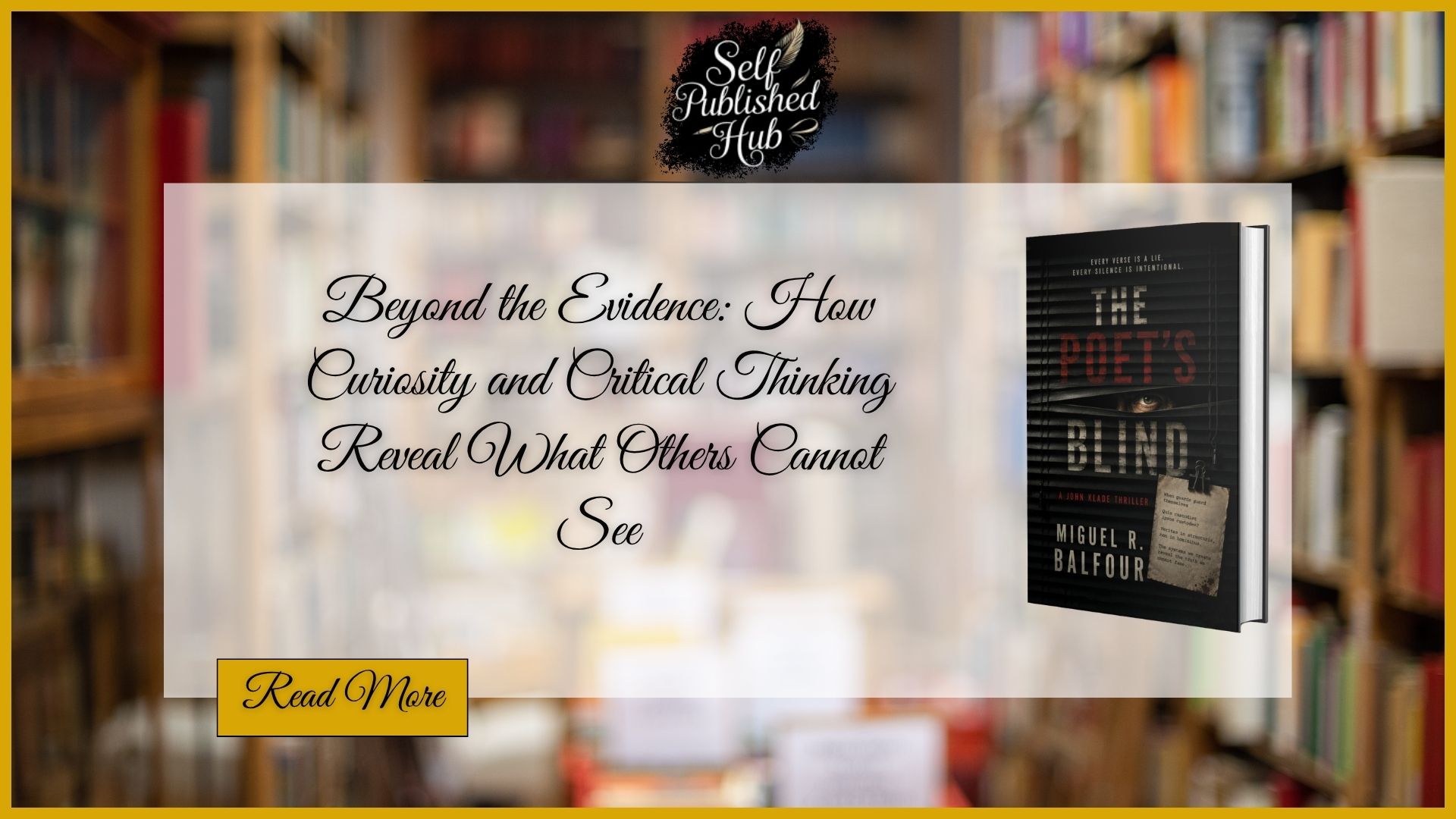
This is one of the ideas explored in my novel, The Poet’s Blind.
The story follows John Klade, a former military and intelligence operative whose ability to recognize patterns draws him into a series of meticulously constructed murders.
The crimes appear to leave investigators a trail.
There are victims.
There are poems.
There are symbolic details.
There are connections.
But Klade gradually begins to question whether the evidence is simply revealing information—or whether someone is deliberately controlling how that information will be interpreted.
That changes the nature of the investigation.
Instead of asking only:
“What does this clue mean?”
Klade has to consider:
“Why was this clue left for us to find?”
And then an even more difficult question emerges:
“What conclusion does someone want us to reach?”
The distinction between those questions is significant.
A person attempting to hide the truth might simply remove evidence.
A person attempting to manipulate an investigation could do something far more sophisticated: provide evidence that leads investigators toward a carefully constructed explanation.
In that situation, the investigator is not merely searching for information.
The investigator is trying to determine whether the information itself can be trusted.
Curiosity Changes the Questions We Ask
This is where curiosity becomes more than simple interest.
Curiosity changes the direction of an investigation.
Instead of asking only:
What happened?
we begin asking:
Why did it happen this way?
Instead of:
What does this detail prove?
we ask:
What else could this detail mean?
Instead of:
How does this evidence support my theory?
we ask:
What would I expect to see if my theory were wrong?
These questions create space for possibilities that might otherwise be ignored.
They also encourage intellectual humility.
Being willing to say “I don’t know yet” can be more useful than forcing an incomplete explanation into a conclusion simply because uncertainty feels uncomfortable.
Looking for What Does Not Fit
Sometimes the most important clue is not what fits the pattern.
It is what doesn’t.
An unusual detail.
An unexplained decision.
A contradiction.
Something that appears insignificant but refuses to make sense within the accepted explanation.
These details can be easy to dismiss because they do not immediately contribute to the story we are already building.
But that is precisely why they deserve attention.
When everything appears to fit perfectly, it may be worth asking whether we have overlooked something—or whether the pattern itself is being presented too neatly.
In The Poet’s Blind, John Klade’s ability to recognize patterns is important. But equally important is his willingness to question those patterns when they become too convenient.
The ability to see connections matters.
The ability to question those connections matters just as much.
Critical Thinking Does Not Mean Doubting Everything
Critical thinking is sometimes misunderstood as constant skepticism.
It is not.
We cannot function by questioning every fact, every decision, and every explanation indefinitely.
Critical thinking is better understood as the ability to match our confidence to the strength of the evidence.
Strong evidence can justify strong conclusions.
Incomplete evidence should leave room for uncertainty.
And when something seems unusually simple, unusually convenient, or unusually certain, curiosity can provide a reason to look again.
This applies to investigations, but also to everyday life.
Before deciding that a business problem has one obvious cause, ask what else could be contributing.
Before deciding what someone intended, distinguish what they actually did from the meaning you assigned to it.
Before deciding that a failure proves something about your abilities, consider what the experience may actually be telling you.
The goal is not to find doubt everywhere.
It is to avoid becoming blind to possibilities simply because the first explanation feels comfortable.
The Questions That Reveal More
Curiosity often begins with surprisingly simple questions:
What am I missing?
What does not fit?
What assumption am I making?
What other explanation could account for the same facts?
Why does this detail matter?
Who benefits from this interpretation?
What would change my mind?
None of these questions guarantees that we will find the truth.
But they make it less likely that we will stop searching too early.
Beyond the Evidence
The central idea behind The Poet’s Blind is not simply that clues can be misleading.
It is that the interpretation of evidence can become part of the problem.
Facts can be accurate while the story constructed from those facts is wrong.
Patterns can be real while their meaning remains misunderstood.
And an explanation can be convincing without being complete.
That is why curiosity matters.
It encourages us to look beyond what is immediately visible. Critical thinking helps us examine what we find. And humility reminds us that understanding is not the same as certainty.
Sometimes the answer is hidden because information is missing.
Sometimes it is hidden because we are looking in the wrong direction.
And sometimes, the most revealing discovery begins when we stop asking whether the evidence supports our explanation and start asking a different question:
What else could this mean?