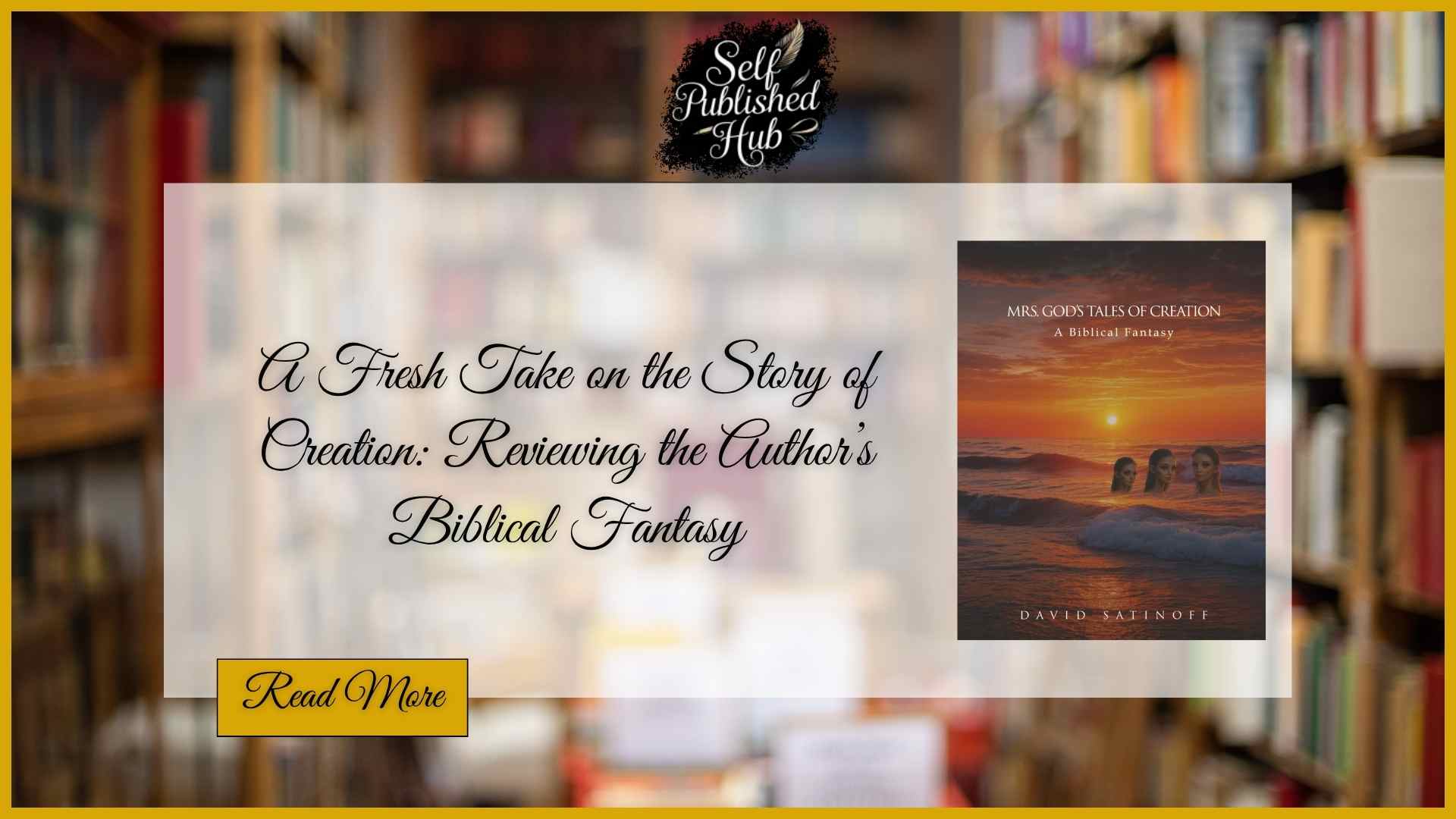
Creation stories are often told with reverence, certainty and a clear sense of divine authority. The author’s Mrs. God’s Tales of Creation: A Biblical Fantasy takes a very different route.
Instead of presenting Creation from the familiar perspective of prophets, theologians or scripture, Satinoff hands the story to Rachel, Mrs. God.
That choice immediately changes everything.
Rachel is not an unquestioning believer. She describes herself as a former nonbeliever with a sharp mind, a skeptical streak and a willingness to challenge ideas that do not make sense to her. Her role as God’s wife gives her unusual access to the Creator, but more importantly, it gives readers a narrator who is comfortable asking the difficult questions most people would hesitate to voice.
Creation Through a Skeptic’s Eyes
One of the most enjoyable aspects of the book is the tension between belief and doubt.
Rachel has met God, spoken with Him and even married Him, yet that does not mean her curiosity disappears. She continues to question long-held assumptions about divine power, human existence, free will, suffering and the nature of Creation itself.
This makes the book feel less like a traditional retelling and more like an extended thought experiment.
Satinoff’s God is also far from conventional. He is portrayed as powerful, but not always certain. He can be loving, humorous, sensitive, lonely, self-conscious and sometimes unsure of the limits of His own abilities. Rachel even describes Him as imperfect and deeply human in temperament.
That portrayal gives the story its most provocative idea: perhaps understanding God becomes more interesting when He is allowed to have doubts, too.
Humor Meets Philosophy
Despite the size of its questions, Mrs. God’s Tales of Creation is not relentlessly serious.
Much of its personality comes from the playful exchanges between Rachel and God. Their conversations can move quickly from theology and philosophy to teasing, romance and ordinary marital disagreements. The manuscript refers to these sections as “The Godd Couple” and they bring a theatrical, conversational quality to the story.
That mixture of the cosmic and the domestic is often where the book is most entertaining.
One moment, the couple may be discussing whether God can truly manage every prayer and every human life. The next, they sound like two spouses trying to understand each other.
A Book That Prefers Questions
Satinoff also explores the burden that comes with humanity’s expectations of God. Rachel learns that her husband may not be capable of monitoring every soul, controlling every destiny or solving every crisis as effortlessly as people assume.
Rather than weakening the premise, this makes the story more interesting.
The book repeatedly chooses curiosity over certainty.
Can God make mistakes? Can He suffer from loneliness? Are some events beyond His control? What if Creation itself involved improvisation rather than perfection?
These are bold questions and the novel clearly enjoys asking them.
For readers who prefer conventional religious fiction, Satinoff’s approach may feel deliberately irreverent. But for readers who enjoy satire, speculative theology, philosophical fantasy and unusual interpretations of familiar stories, Mrs. God’s Tales of Creation offers something genuinely distinctive.
It is not simply a new version of Creation.
It is a conversation about Creation led by the one person willing to ask God what really happened.