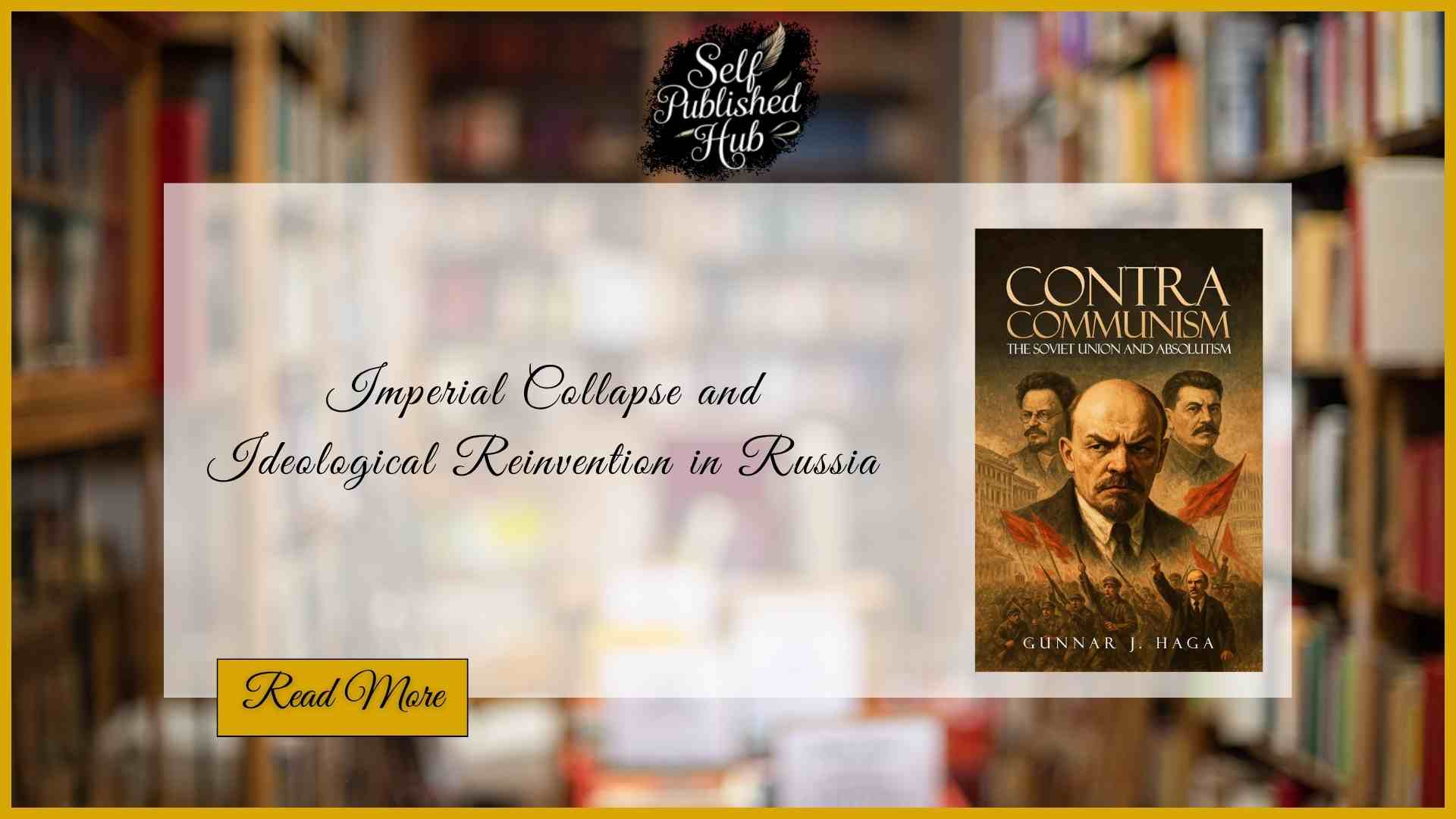
The collapse of imperial Russia in the early 20th century is often told as a straightforward story: a fallen monarchy, a revolutionary uprising and the emergence of the world’s first communist state. But Contra Communism by Gunnar J. Haga challenges this familiar narrative at its core. Instead of viewing the Soviet Union as the realization of communist ideology, the book reframes it as something far more historically complex and far less ideologically coherent.
At the heart of this reinterpretation lies a central claim: the Soviet Union was not communism, but a transformation of Russian absolutism into a totalitarian system.
From Empire to Rupture: A System Under Pressure
Imperial Russia was a state marked by deep structural imbalance. While Western Europe had largely transitioned beyond feudal systems and moved through stages of constitutional and capitalist development, Russia remained tied to older forms of hierarchy and centralized authority. Even as modernization pressures increased in the 19th century, the country retained strong feudal remnants layered beneath a powerful autocratic structure.
According to Haga’s analysis, this made Russia historically “out of sync” with Western political evolution. When the collapse came in 1917, it did not simply open the door to socialism; it exposed a vacuum of institutional development. The old imperial order did not transition smoothly into democracy or capitalism. Instead, it fractured.
The Revolution and the Reinvention of Power
The Bolshevik Revolution is typically described as the birth of a socialist state. However, Contra Communism argues that what followed was not the construction of communism, but the reinvention of centralized power under a new ideological vocabulary.
Lenin and Trotsky envisioned a classless and stateless society, yet the system that emerged became increasingly centralized and hierarchical. In practice, political authority flowed strictly from the top down. The one-party structure absorbed state institutions, eliminating meaningful opposition and concentrating control over production, politics and social life.
Rather than dissolving class distinctions, a new governing layer emerged, an administrative and party elite that managed the state apparatus.
Absolutism in a Modern Form
One of the book’s most important contributions is its reinterpretation of Soviet governance through the lens of absolutism evolving into totalitarianism.
In Western Europe, absolutism historically functioned as monarchic centralization that gradually gave way to constitutional limits and democratic institutions. In Russia, however, absolutist tendencies did not evolve toward liberalization before the revolution occurred. Instead, they were reconfigured into a modern ideological state.
This produced what Haga describes as totalitarian absolutism: a system in which political legitimacy was claimed through ideological language, while real power remained entirely centralized. Even institutions named to suggest grassroots participation, such as “soviets,” ultimately operated under strict state control.
The Illusion of Ideological Continuity
A key argument in Contra Communism is that Soviet ideology created a powerful illusion of continuity with Marxist thought. Yet Marx’s model of historical development, from feudalism, capitalism and then communism, assumes the prior emergence of capitalism as a structural stage. Russia, however, attempted to bypass this sequence.
The result, Haga suggests, was a system that borrowed Marxist terminology while departing from its structural logic. The label “Marxism-Leninism,” therefore, becomes less a unified ideology and more a post hoc justification for a political system that evolved differently from its theoretical foundations.
Imperial collapse as Ideological Reinvention
Seen through this lens, the fall of the Russian Empire was not simply a transition from monarchy to socialism. It was a reconfiguration of authority amid collapse, in which ideological frameworks were used to stabilize a rapidly centralizing state.
Even small-scale examples of communal living, such as the Israeli Kibbutz, are used in the book to highlight the difference between voluntary micro-level communism and large-scale state systems that claim ideological purity but operate through centralized control.
Rethinking the Soviet Legacy
Ultimately, Contra Communism invites readers to reconsider the entire trajectory of Russian political development. Was the Soviet Union a failed attempt at communism or a successful transformation of absolutism into a modern ideological form?
By reframing imperial collapse not as ideological fulfillment but as structural reinvention, Gunnar J. Haga opens a new way of understanding Russia’s past and its global significance.
For readers interested in political theory, Russian history and the hidden mechanics of ideological systems, Contra Communism offers a provocative reinterpretation that challenges long-held assumptions and reframes one of the most influential experiments of the modern era.