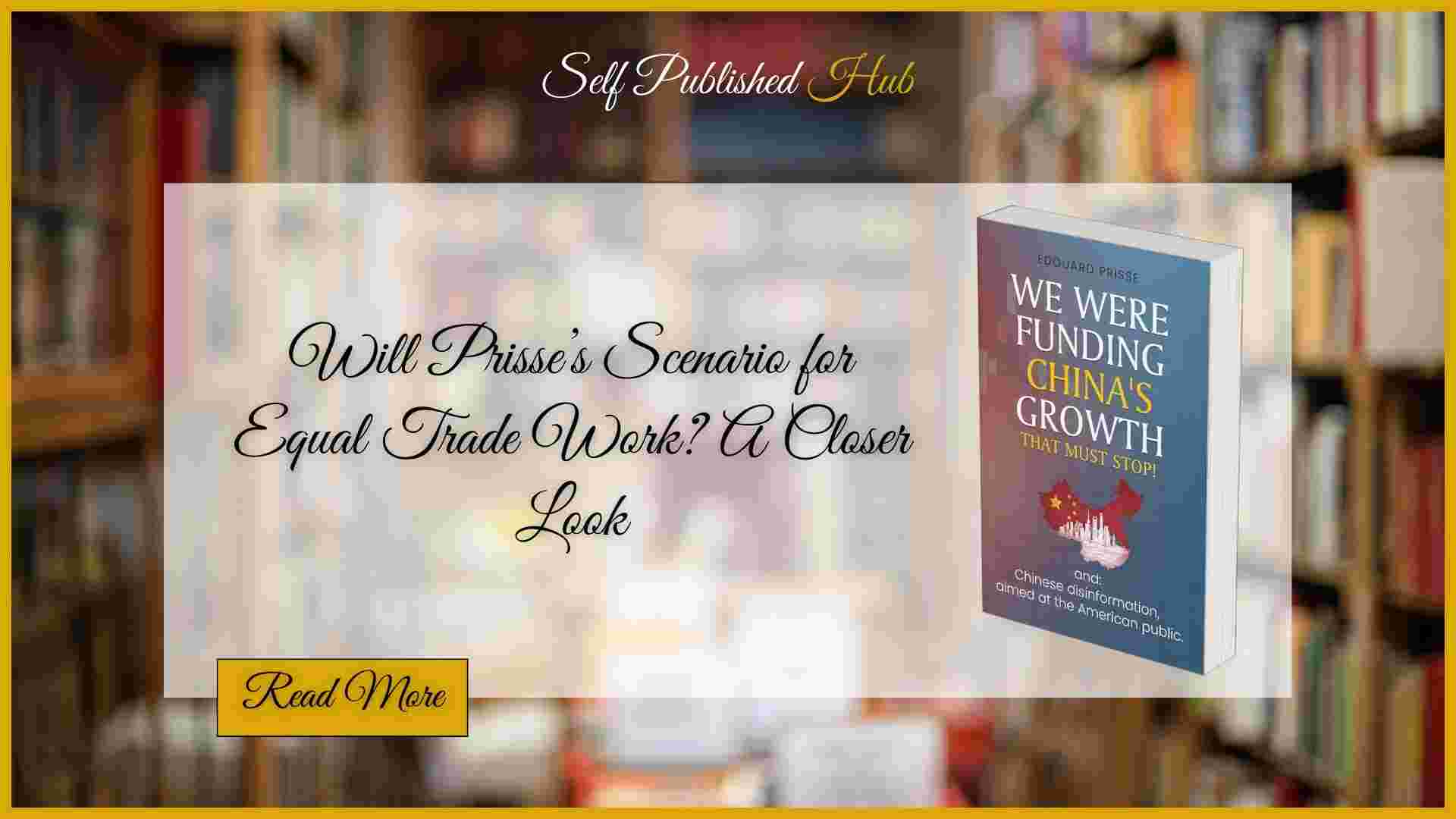
In We Are Funding China’s Growth That Must Stop!, Edouard Prisse puts forward a bold and controversial solution to one of the 21st century’s most pressing geopolitical challenges: the rise of China as an economic superpower funded largely by Western consumption. His proposal is not a return to isolationism or protectionism but a dramatic policy shift he calls “Equal Trade”—a concept grounded in macroeconomic realism and strategic necessity.
Equal Trade, as outlined by Prisse, means limiting imports from China to an amount equal to what the United States exports to China, not in volume but in monetary value. It’s a reset of trade balance, enforced by strict limits and backed by legal, economic, and political mechanisms. The goal is to stop the annual $600+ billion trade surplus China enjoys with the U.S., which Prisse argues has been fueling Beijing’s military modernization, Belt and Road initiatives, global propaganda efforts, and domestic suppression under authoritarian rule.
But is Equal Trade a viable path forward?
First, consider the economic logic. China’s competitive advantage lies in its artificially low production costs. This is not the product of market efficiency but of authoritarian labor control, suppressed wages, environmental corner-cutting, and massive state subsidies. Free trade assumes a level playing field. With China, the field is not just tilted—it’s deliberately engineered to drain wealth from open societies. Equal Trade isn’t a punitive response. It’s a corrective one.
Second, Prisse offers a roadmap. The U.S. government would announce a phased transition: a six-month window to begin implementing Equal Trade measures. A newly established Export-Import Trade Bureau would enforce restrictions, supported by specific exemptions for non-strategic sectors like apparel. American companies would be incentivized to reshore manufacturing or redirect supply chains to other democracies or developing economies with ethical labor practices.
The objections are predictable: industry pushback, price increases, supply chain disruptions, possible retaliation from Beijing. But Prisse is not naive. He anticipates these challenges and argues that the cost of inaction—continued strategic dependence on a hostile regime—is far greater. The U.S. did not become a superpower by outsourcing its economic base. Reclaiming industrial capacity is not just economic policy. It’s national security.
What makes Prisse’s scenario compelling is that it’s not driven by ideology but by cold economic facts. China’s foreign exchange reserves—over $3 trillion—are the result of a trade structure that benefits Beijing disproportionately. These reserves fund influence campaigns, leverage debt-trap diplomacy in weaker nations, and give China a geopolitical tool that even its military might can’t match. Equal Trade doesn’t destroy trade. It rebalances it so that America doesn’t subsidize its own decline.
Critics may argue that a free-market system shouldn’t impose artificial limits. But Prisse turns that critique on its head. What exists today isn’t free market competition—it’s a state-backed economic strategy by China that exploits the West’s ideological rigidity. Equal Trade is not anti-trade. It’s pro-fairness, pro-security, and pro-democracy.
The biggest obstacle isn’t economic feasibility—it’s political will. Implementing Equal Trade requires courage from the White House and Congress, resistance to corporate lobbying, and a willingness to inform the electorate about the long-term implications of current policy. But if communicated effectively, the public could embrace it. Americans are ready to stop funding regimes that threaten their freedom.
Prisse’s scenario may seem radical. But compared to the alternative—continued economic erosion, strategic dependence, and geopolitical retreat—it is a reasonable response to an extraordinary challenge.