There is a quiet pattern in history. Those who question dominant systems are rarely met with curiosity. More often, they are dismissed, isolated, or labelled. The language used to describe them shifts depending on the era, but the intent remains the same: to reduce reliability before the ideas can be fully considered.
In modern society, one of the most common labels attached to dissenting voices is paranoia. It is a powerful word. It does not simply challenge a claim; it questions the stability of the person making it. Once applied, it becomes difficult for any argument to stand on its own factors. The focus moves away from what is being said and onto who is saying it.
This raises an important question. At what point does perception become paranoia? And who decides where that line exists?
The distinction is rarely as clear as it appears. Perception often begins with observation. Patterns are noticed. Connections are made. Questions follow. These are not inherently irrational processes. In fact, they are the foundation of critical thinking. Yet when those observations challenge widely accepted structures, they can be reframed as delusion.
Society tends to protect its frameworks. Systems of governance, authority, and belief rely on a degree of collective agreement. When that agreement is disrupted, even slightly, there is a natural resistance. Dissent introduces uncertainty, and uncertainty can feel threatening. Labelling dissent as paranoia becomes a way to restore order without engaging in uncomfortable debate.
But history shows that many ideas once dismissed later gained recognition. Scientific breakthroughs, social reforms, and cultural shifts often began with individuals who were not taken seriously. Their perceptions did not align with accepted norms at the time, yet they persisted.
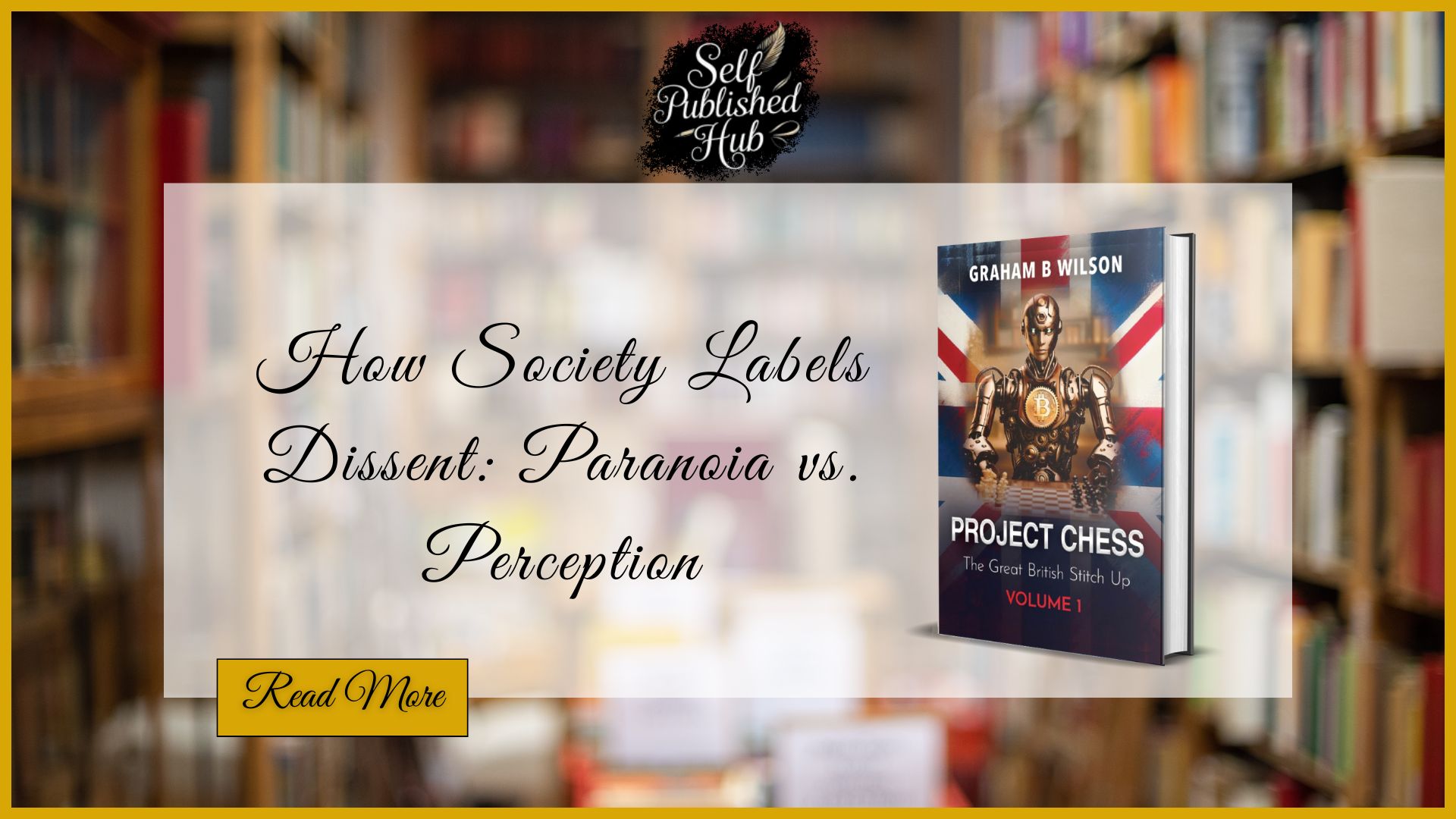
This tension between perception and dismissal is explored with striking intensity in Project Chess: The Great British Stitch Up, Volume One by Graham B Wilson. The narrative does not simply present a story. It places the reader inside the mindset of someone who feels unheard, misunderstood, and systematically challenged. It asks the reader to sit with discomfort rather than avoid it.
What makes the book compelling is not whether one agrees with every claim. It is the way it captures the experience of being labelled. The frustration. The isolation. The constant questioning of one’s own reality. These elements resonate on a human level, regardless of interpretation.
The book also pushes further. It invites readers to consider how easily perception can be dismissed when it does not align with dominant narratives. It suggests that the boundary between rational concern and perceived paranoia is not fixed, but influenced by context, power, and perspective.
This does not mean every dissenting idea is accurate. Critical thinking requires evaluation, evidence, and balance. However, the automatic rejection of unconventional perspectives can be just as limiting as blind acceptance. The challenge lies in navigating that middle ground where ideas are examined rather than silenced.
In a world shaped by information, influence, and rapid communication, the ability to question remains essential. So does the responsibility to listen. Not every voice will be correct, but every voice reflects a perception shaped by experience.
Project Chess: The Great British Stitch Up, Volume One stands as a bold and unsettling exploration of this dynamic. It does not offer easy answers. Instead, it challenges readers to reconsider how quickly society labels, how easily perception is dismissed, and how thin the line can be between being heard and being written off.
For those willing to engage with complex ideas and confront uncomfortable questions, this is not just a book. It is an experience that lingers long after the final page.
The book is available on https://www.amazon.com/dp/B0G4VFBH6Z.