Fantasy often gives writers permission to do something reality cannot: bend the rules.
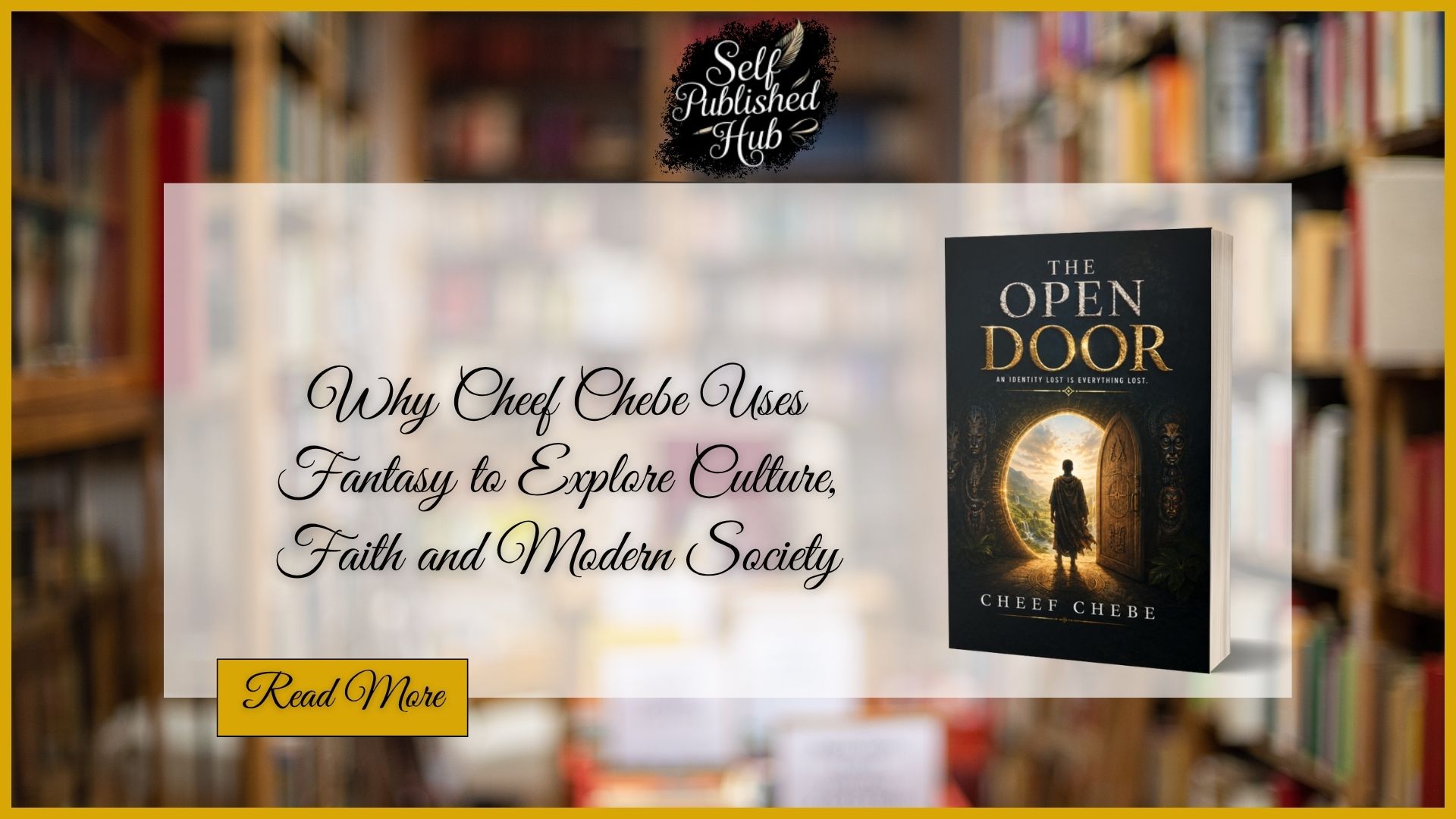
In The Open Door, author Cheef Chebe uses that freedom to create a world where reincarnation, invisible voices, soul travel, spiritual dimensions, ancestral memory and strange new realms can exist alongside very real questions about identity, religion, mental health, leadership, inequality and modern life.
Rather than using fantasy simply as an escape, Chebe turns it into a tool for reflection.
At the center of the story is Djambay, a man who awakens in a mysterious treehouse without fully understanding who he is or how he arrived there. As pieces of his identity return, he learns that he was once known as Dr. Peter Morgan and had lived in Glasgow. He also begins reconnecting with an older identity rooted in African ancestry, family traditions and spiritual knowledge.
That tension between past and present gives the book much of its emotional and philosophical energy.
Fantasy Creates Space to Question Culture
One of the most interesting aspects of The Open Door is the way it explores cultural identity.
Djambay’s memories lead him back to his grandfather and to traditional knowledge involving healing, nature, community and ancestral practice. At the same time, he remembers how those traditions were sometimes dismissed as primitive or incompatible with modern education.
Through fantasy, Chebe is able to revisit that conflict from a new perspective.
The book does not simply ask readers to choose between tradition and modernity. Instead, it raises broader questions. What knowledge gets respected? Who decides which beliefs are acceptable? What happens when people become disconnected from their cultural roots?
Djambay’s unusual journey gives those questions a dramatic setting.
Faith Becomes a Conversation Rather Than a Boundary
Religion also plays a major role in the story.
As Djambay travels through strange dimensions and encounters the Ambatarian tradition, he begins questioning rigid divisions between faiths. Christianity, Islam, African spirituality and other belief systems enter the narrative as part of a larger conversation about God, humanity and coexistence.
Chebe uses the supernatural world of The Open Door to imagine spirituality beyond familiar boundaries.
That does not make the story a simple religious argument. Instead, it becomes an exploration of how people understand the divine, why belief can divide communities and whether compassion and shared humanity can become stronger than labels.
A Fantasy World That Reflects Our Own
Perhaps the most striking thing about The Open Door is how often its imaginative world points readers back toward modern society.
The story touches on consumerism, social media judgement, mental health, loneliness, inequality, war, technology, artificial intelligence, environmental concerns and the pressure to define success through material possessions.
Even the City of Light and Chebe’s vision of a better society function as more than fantasy locations. They invite readers to consider whether cooperation, service, sustainability and fairness could replace some of the competition and division shaping everyday life.
This is where fantasy becomes especially powerful.
By creating a world that operates differently, Chebe encourages readers to look again at the one they already inhabit.
The Open Door is ultimately a journey through strange places, but its biggest questions remain deeply human: Who are we? What should we believe? What have we forgotten? And what kind of world do we want to create?
For readers who enjoy imaginative storytelling with philosophy, cultural reflection, spirituality, satire and social commentary woven throughout, Cheef Chebe’s The Open Door offers a journey designed to keep both the imagination and the mind engaged.
Read the book on Amazon: https://www.amazon.com/dp/B0HKXFPZLN/