Political struggle often presents itself along two distinct paths: the use of force and the power of ideas. While both have shaped history in profound ways, they operate on fundamentally different principles. Understanding the tension between political violence and ideological resistance reveals not only how movements emerge, but how they sustain themselves and ultimately define their legacy.
Political violence is typically born out of urgency. When systems appear immovable and avenues for reform are blocked, force is often seen as the only remaining option. It seeks immediate disruption, aiming to dismantle structures of power through confrontation. In certain contexts, it can accelerate change by forcing attention and creating pressure where none existed before. However, its effectiveness is often limited by its reliance on short term outcomes. Violence can remove hurdles, but it does not inherently provide a framework for what comes next.
Ideological resistance, by contrast, operates on a longer timeline. It is rooted in the transformation of thought, belief, and collective identity. Rather than targeting structures directly, it reshapes the foundation upon which those structures stand. This approach focuses on building awareness, fostering unity, and creating a shared vision that can sustain change over time. It is less visible in its early stages but often more enduring in its impact.
The distinction between the two is not always absolute. Many movements have employed both approaches, navigating a complex balance between action and persuasion. Yet the psychological and strategic implications differ significantly. Political violence demands discipline and control to avoid descending into chaos. Ideological resistance demands consistency and clarity to maintain credibility and influence.
One of the central challenges with political violence is legitimacy. While it may arise from justified grievances, its perception can vary widely depending on perspective. Actions intended as resistance may be viewed as destabilizing or unjustified by others. This ambiguity can weaken support, both internally and externally, making it difficult to sustain consistency.
Ideological resistance, on the other hand, derives strength from its ability to attract and unify. When individuals adopt a shared set of beliefs, they become active participants in a movement rather than passive observers. This internalization creates resilience. Even in the face of setbacks, the movement persists because it exists not only in institutions but in the minds of its supporters.
Another key difference lies in sustainability. Political violence often requires continuous escalation to maintain its effectiveness, which can strain resources and fracture unity. Ideological resistance, however, can expand organically.
Leadership plays a critical role in navigating these approaches. Decisions about when to confront and when to persuade are rarely straightforward. Leaders must assess not only the immediate situation but also the long term consequences of their actions. A movement that relies too heavily on force risks losing its moral foundation. One that relies solely on ideas may struggle to overcome entrenched opposition. The balance between the two defines the trajectory of the struggle.
Ultimately, the question is not which approach is superior, but how they interact. Political violence can create openings, but ideological resistance determines whether those openings lead to lasting transformation. Without a guiding framework of ideas, change remains fragile. Without the capacity to confront power, ideas may never move beyond theory.
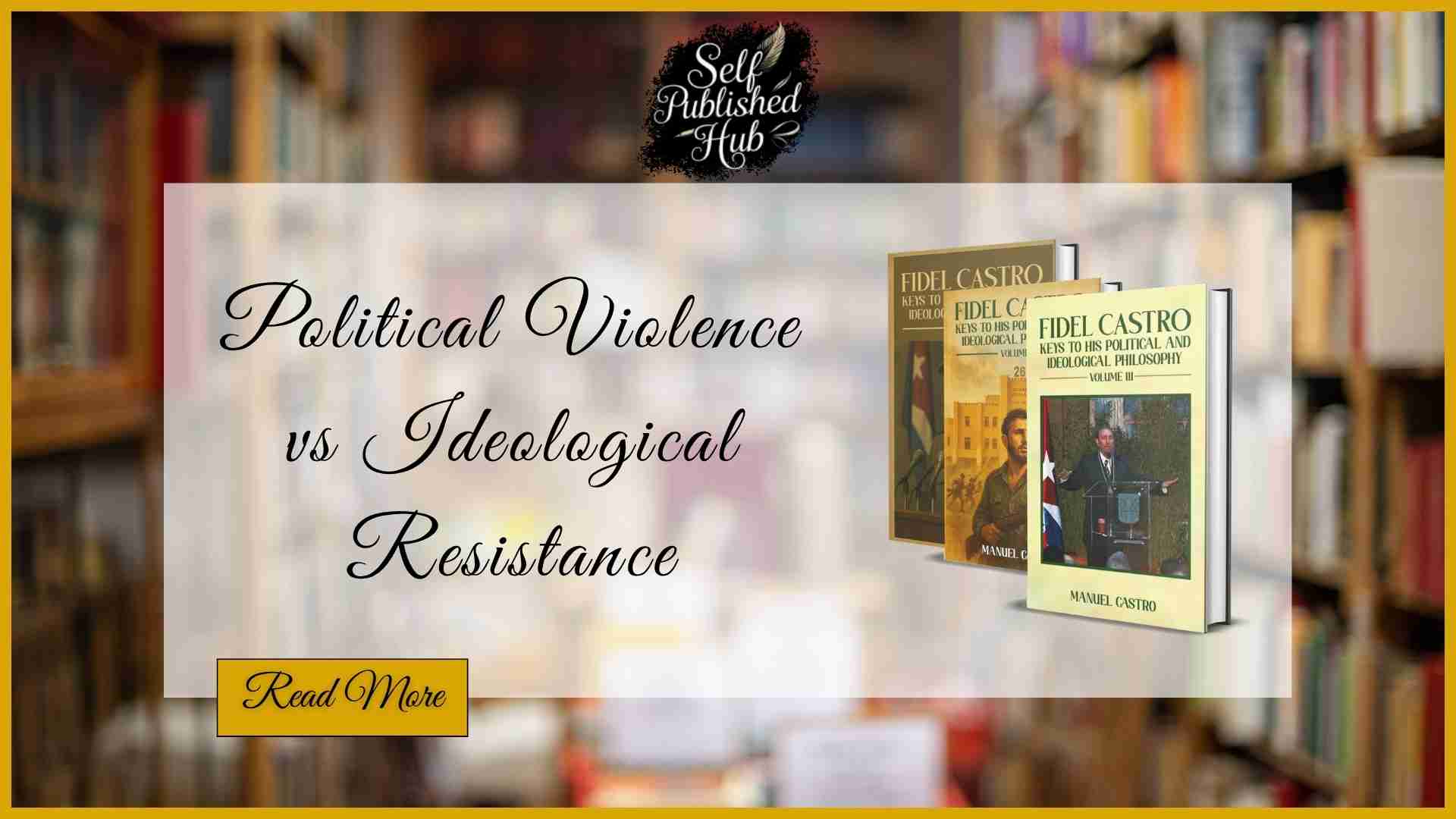
For readers seeking a deeper understanding of how these dynamics unfold in real political contexts, Fidel Castro: Keys to His Political and Ideological Philosophy by Manuel A. Castro offers a comprehensive examination. The work explores the interconnection between resistance, strategy, and ideological formation, providing insight into how movements navigate the complex relationship between force and thought.
Head to Amazon to purchase your copy: https://www.amazon.com/dp/197213454X