We have officially entered the era of digital crime. What once was part of the movies now becomes a living reality, as we get to see how common cyberattacks are used to target and dismantle security systems and used to steal data of different kinds.
With modern and more advanced cybersecurity concerns, modern threat hunting should no longer be about waiting for a noisy antivirus alert to pop up on a screen and showing us who has already bypassed traditional perimeter controls. Today’s advanced attackers move quietly, blending in with legitimate user activity and hiding deep within complex enterprise architectures. To uncover these invisible intrusions, security teams and cybersecurity professionals must rely on Security Information and Event Management (SIEM) platforms as their ultimate investigative command center. By aggregating massive volumes of data, modern SIEM architectures give hunters the deep visibility, behavioral context, and analytical tools needed to expose hidden threats before they detonate.
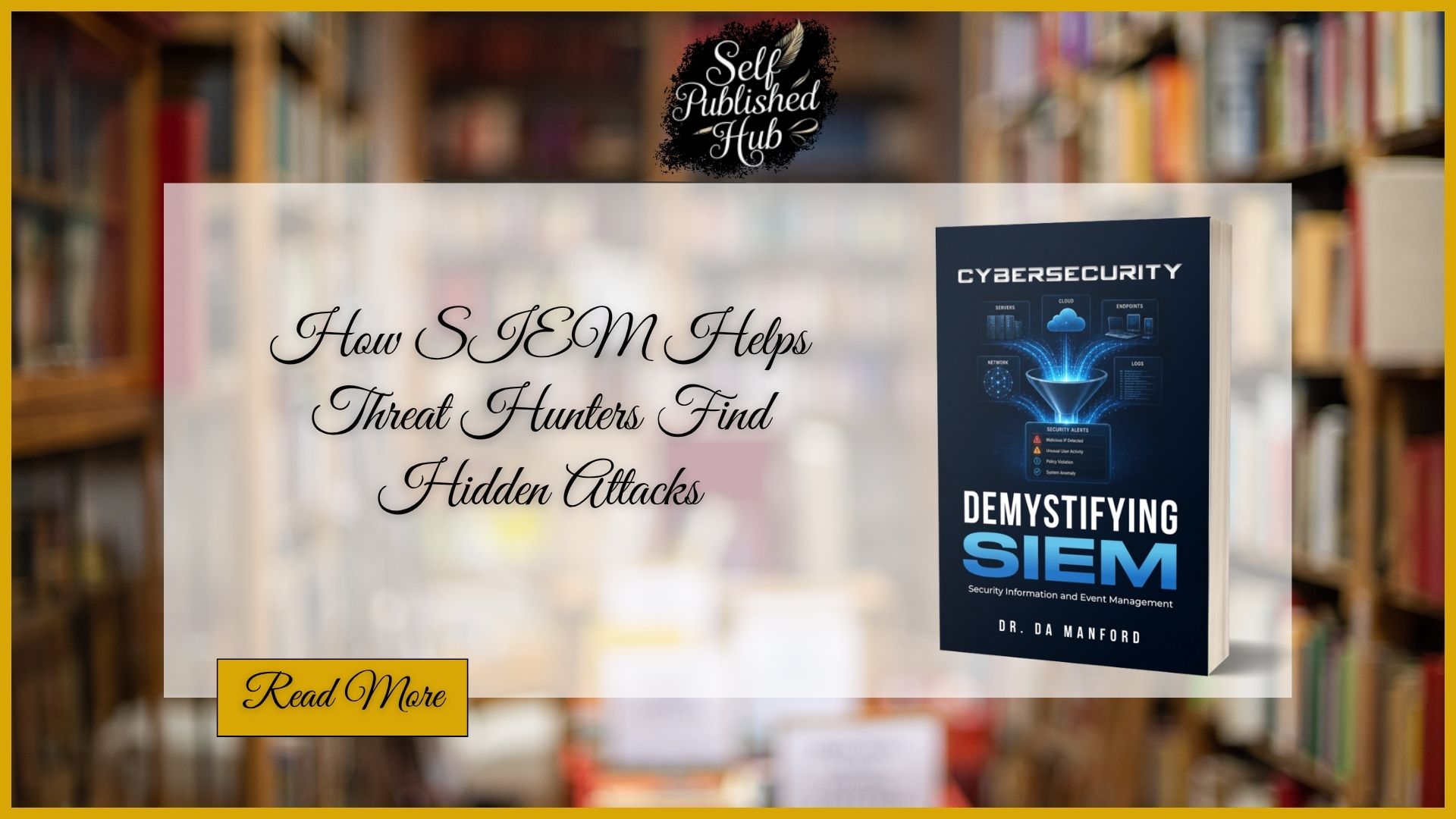
In this regard, Demystifying SIEM: Security Information and Event Management by Dr David A. Manford is a practical guide that explains the principles, architecture, and operational value of Security Information and Event Management in modern cybersecurity. The book explores how SIEM platforms collect, normalise, and analyse security data to provide visibility, detect threats, support incident response, and strengthen security operations. It also covers essential topics including security data management, threat detection, log collection, correlation and analytics, SOC workflows, SIEM deployment strategies, tuning and optimisation, common challenges, and the evolving relationship between SIEM, SOAR, XDR, cloud security, and artificial intelligence.
Written for security professionals, leaders, students, and those entering the cybersecurity field, it provides a clear foundation for understanding how organisations can implement and maximise SIEM to improve resilience against modern cyber threats and looming security threats.
Uncovering Anomalies Through Behavioral Detection
Traditional security defenses have long relied on static signatures, including matching known malware hashes or blocklisting specific IP addresses. However, modern adversaries easily evade these rigid mechanisms by using living-off-the-land techniques, legitimate administrative tools, and stolen credentials. Having a SIEM changes the game, as instead of looking for a specific malicious file, behavioral monitoring establishes a baseline of normal activity for every user, endpoint, and application across the organization; it allows users to track patterns. They can better track and evaluate: When does an administrator typically log in? From what geographic location? What file volumes do they usually access? When an attacker compromises an account and attempts to move laterally, their behavior deviates from this baseline, and the SIEM flags these subtle shifts, such as an accountant accessing sensitive engineering blueprints at 3:00 AM, turning invisible human behavior into a glaring red flag for threat hunters.
Mapping the Attack Lifecycle for Complete Visibility
Advanced persistent threats rarely occur as isolated incidents; they unfold over days, weeks, or months across a multi-stage attack lifecycle. An adversary might initially gain a foothold via a routine phishing email, escalate privileges through an unpatched local vulnerability, quietly establish command-and-control communication, and finally stage data for exfiltration.
Isolated tools only see narrow fragments of this journey, blinding teams to the broader picture. A modern SIEM stitches together these disparate events across cloud environments, endpoints, and identity providers. By mapping telemetry against frameworks like MITRE ATT&CK, threat hunters gain end-to-end visibility across the entire attack lifecycle. They can trace an incident backward from the point of discovery to the original vector or forward to see every system the attacker touched. This comprehensive view eliminates operational blind spots and ensures that remediation addresses the root cause rather than just trimming the symptoms.
Investigating Suspicious Patterns With Contextual Agility
Finding a raw anomaly is only half the battle; the real work lies in deep investigation. When a suspicious pattern emerges, threat hunters must pivot quickly between data views, examine historical logs, and pull in threat intelligence to determine if an alert represents a true intrusion or a benign operational quirk.
Modern SIEM platforms support this intricate investigative dance by providing intuitive visual timelines, alert clustering, and rapid data-pivoting capabilities. Hunters can drill down into specific user sessions, correlate authentication attempts with endpoint process execution, and analyze historical baselines in real time. This contextual depth empowers analysts to cut through the noise, separate false positives from targeted attacks, and build an airtight narrative of how an adversary operated inside the network.
Ultimately, hidden attacks thrive in silos and fragmented logs. By leveraging a centralized SIEM for behavioral analysis, lifecycle mapping, and deep pattern investigation, threat hunters shift from a reactive stance to an aggressive, proactive defense—stopping sophisticated adversaries long before they can achieve their objectives.
Read the book on Amazon: https://a.co/d/09kt91XG