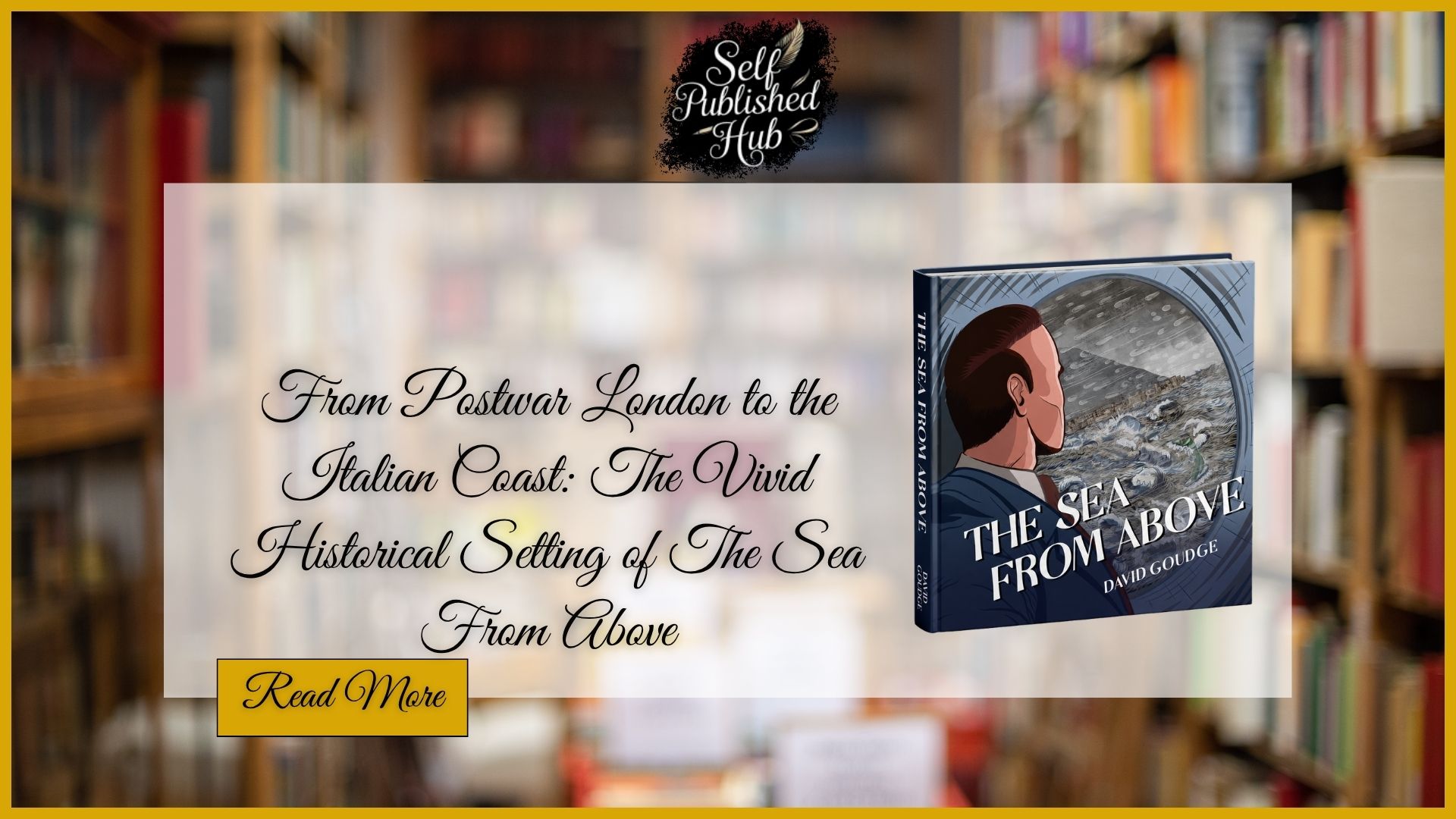
Some historical novels use the past as scenery. David Goudge’s The Sea From Above does something more immersive: it lets the setting shape the characters’ choices, fears, ambitions and relationships.
From the crowded streets and theatres of postwar London to the open skies and dramatic coastline of Italy, the novel moves through places that feel closely tied to the lives unfolding within them. The result is a story where location is never just background. It becomes part of the emotional experience.
A London Full of Possibility and Risk
For the Younger Man, London represents a new beginning.
He arrives from Leeds, unfamiliar with the Underground and excited by the possibilities of the capital. His new home is a tiny attic flat nicknamed “Chatsworth,” surrounded by theatre life, nightlife and the constant movement of the city.
London gives him access to experiences he could not easily have imagined before. Theatres, clubs, fashionable bars, new friendships and opportunities to discover more about himself surround him.
But the city also has a darker side.
The novel makes clear that for a gay man in the 1950s, freedom could never be taken for granted. The Younger Man is warned about police entrapment, blackmail, hostile landlords and violence. That danger becomes painfully real when he is followed and attacked in the street.
This contrast makes Goudge’s London especially effective. It is exciting and threatening at the same time, a place where a person can begin again, yet still has to remain alert.
Cinema Opens the Door to Another World
The story expands when the Younger Man is offered work on a film production in Italy.
The opportunity feels enormous. He has only recently been establishing himself in London and now he is being asked to travel abroad as part of a professional wardrobe department.
The change in location also shifts the novel’s emotional scale.
London is intimate, crowded, smoky and full of hidden social rules. Italy introduces distance, sunlight, landscape and the excitement of filmmaking on location. The journey itself becomes important because it suggests that life can become larger than the boundaries the characters have known.
Seeing the Mediterranean From Above
One of the novel’s most striking passages comes through the Other Man as he looks down from an aircraft while travelling toward Italy.
He studies coastlines, mountains, roads, islands and the Mediterranean far below. The view fascinates him so completely that the earth seems to unfold like a story beneath the plane. Eventually, his attention settles on the water, “the sea from above.”
That image gives the novel more than its title.
Seen from a great height, borders blur. Landscapes become patterns. Problems that seem enormous at ground level can look strangely different from another perspective.
That idea quietly reflects the journeys of the characters themselves.
A Setting That Mirrors Change
The movement from London to Italy gives The Sea From Above a strong sense of expansion. The characters travel geographically, but they also move through memories, identities, fears, desires and possibilities.
That is why the historical setting feels so important.
David Goudge does not simply transport readers to the 1950s. He creates a world of theatres, film crews, smoke-filled rooms, risky streets, aircraft cabins, Mediterranean landscapes and people trying to work out where they belong.
For readers who enjoy atmospheric historical fiction with strong characters and a vivid sense of place, The Sea From Above offers a journey worth taking.
Discover The Sea From Above by David Goudge and travel from postwar London to the Italian coast through a story of identity, courage, memory and change.
Get the book: https://www.amazon.com/dp/B0H533K7N1